Concrete Calculator
Enter your slab dimensions and get cubic yards, bag counts, and a cost estimate in one screen. The formula is printed below the tool so you can check every number. Choose a slab, footing, wall, round column, or set of steps. The calculator is free to use, with no account required. Bag counts are rounded up to whole bags.
How to use the concrete calculator
Results update instantly
Estimate
- Order volume
- 1.23 cu yd
- 80 lb bags
- 56
- 60 lb bags
- 75
- 40 lb bags
- 112
Based on the dimensions you entered.
How do I measure a concrete slab?
How much concrete does a slab need at different thicknesses?
Volumes below assume a uniform slab depth and no extra material. Add separate volumes for thickened edges or other parts of the pour.
| Area (sq ft) | 4 in (cu yd) | 5 in (cu yd) | 6 in (cu yd) |
|---|---|---|---|
| 25 | 0.31 | 0.39 | 0.46 |
| 50 | 0.62 | 0.77 | 0.93 |
| 75 | 0.93 | 1.16 | 1.39 |
| 100 | 1.23 | 1.54 | 1.85 |
| 125 | 1.54 | 1.93 | 2.31 |
| 150 | 1.85 | 2.31 | 2.78 |
| 200 | 2.47 | 3.09 | 3.7 |
| 300 | 3.7 | 4.63 | 5.56 |
Concrete cost per cubic yard
The live estimate uses retail examples for 80 lb bags and supplier examples for ready-mix. The table shows material costs for a 10 × 10 ft slab at 4 in thick, before tax and fees.
- Bagged material
- $391.44–$503.44
- Bulk material
- $192.59–$224.69
| Material | Example quantity | Unit price | Material total |
|---|---|---|---|
| 80 lb concrete mix | 56 bags | $6.99–$8.99 | $391.44–$503.44 |
| Bulk by the yard | 1.23 cu yd | $156.00–$182.00 | $192.59–$224.69 |
Prices exclude delivery, tax, and short-load charges. Ask about minimum truck orders and add a planning allowance for uneven subgrade or spillage. Try 10% as a comparison and adjust it to your job. Ask your supplier how they round orders.
Sources checked November 18, 2026. QUIKRETE Concrete Mix yield data · HEP Sales 80 lb mix · Broadview Hardware 80 lb mix · Gehring ready-mix pricing · American Concrete order minimums and delivery
Concrete calculator formula
- Slab, footing, or wall
- Cubic feet = length (ft) × width or height (ft) × depth or thickness (ft)
- Round columns
- Cubic feet = π × (diameter ÷ 2)² × height × number of columns, with dimensions in feet
- Solid, equal steps
- Cubic feet = width × tread × rise × steps × (steps + 1) ÷ 2, with dimensions in feet
- Convert and round
- Cubic yards = cubic feet ÷ 27. Whole bags = round up [(cubic feet × (1 + extra percent ÷ 100)) ÷ yield per bag].
How much concrete does a 10 × 10 ft slab need?
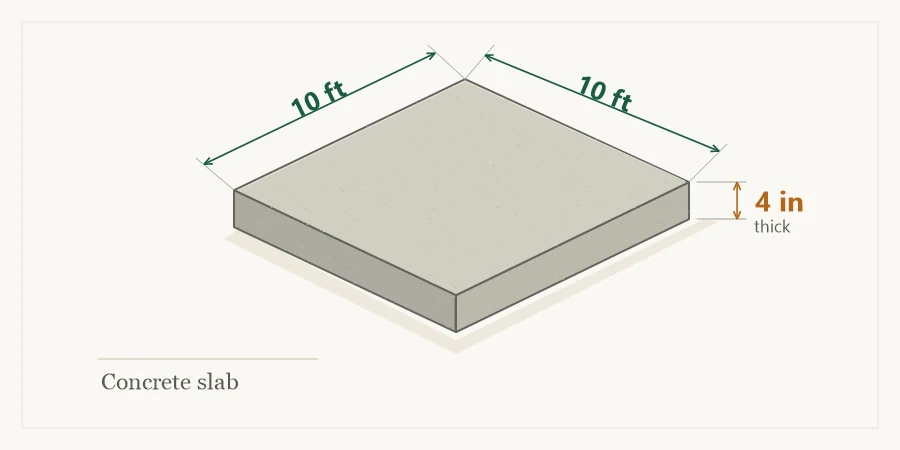
A 10 × 10 ft slab that is 4 in thick uses 10 × 10 × (4 ÷ 12) = 33.33 cu ft. Divide by 27 to get about 1.23 cu yd. An 80 lb bag yields about 0.60 cu ft, so 33.33 ÷ 0.60 = 55.56, which rounds up to 56 bags with no allowance.
How many bags of concrete do I need?
- Divide the volume you plan to pour in cubic feet by the yield printed on the bag, then round up to a whole bag. Yield tells you how much fresh concrete the dry mix makes when prepared as directed.
- The weight on the front of the bag tells you what you have to carry. It does not tell you the density of the mixed concrete.
- For standard QUIKRETE Concrete Mix No. 1101, an 80 lb bag yields about 0.60 cu ft, a 60 lb bag about 0.45 cu ft, and a 40 lb bag about 0.30 cu ft. Check the yield again if you change products.
- For example, an 8 ft by 3 ft walkway at 4 in thick needs 8 cu ft. With no allowance, that is 14 of the 80 lb bags, 18 of the 60 lb bags, or 27 of the 40 lb bags.
- Smaller bags are easier to handle individually, but you will open and empty more of them. If you pick up the 80 lb bags yourself, the dry mix alone weighs 1,120 lb. Check the vehicle’s payload before deciding how many trips to make.
- For several forms you plan to fill in one session, add their volumes before rounding. For separate pours, round each day’s quantity to see how many bags to stage.
- Turn the bag count into a mixing plan before you shop. A mixer that can take two 80 lb bags of this mix at a time makes about 1.2 cu ft per batch, so the walkway takes seven batches. Check the mixer’s actual batch limit and the mix instructions before loading it.
- Estimate the time to measure water, mix, move each load, and return for the next one. Assign someone to place and level the concrete while the next batch is mixing so the entire slab can be filled continuously.
- Bags can make sense for a small pour behind a narrow gate, especially if you can stage them close to the forms. For a larger continuous pour, ready-mix delivery can save a great deal of lifting and mixer time.
- Ask where the truck can stop and whether its chute will reach the forms. If you will need wheelbarrows, a powered buggy, or a pump, include the equipment and people needed to unload at the supplier’s pace. Have the forms and crew ready before the truck arrives.
- Check how the supplier bills fractional yards. For example, a 10 by 10 ft slab at 4 in needs about 1.23 cu yd. With a 10% allowance the order volume is about 1.36 cu yd. If your supplier rounds up in quarter-yard increments, those become billable orders of 1.25 and 1.50 cu yd, respectively.
- Ask where any leftover concrete can go, and compare the billable order with the number of whole bags you would actually buy.
- Compare the full cost for the same order volume. For bags, include pickup or delivery, mixer rental and return time, and cleanup.
- For ready-mix, ask about the minimum order, delivery, short-load fees, and how long you have to unload before waiting charges apply. The better option depends on the site and crew: there is no universal bag count at which a truck becomes cheaper.
QUIKRETE Concrete Mix No. 1101: bag yields and mixing instructions
How do I measure a concrete slab and enter the right units?
- Measure the length and width from the inside faces of the forms. Both fields on the slab calculator use feet. To enter a measurement such as 8 ft 6 in, divide the 6 inches by 12 and enter 8.5. Typing 8.6 gives you 8 ft 7.2 in.
- Measure thickness from the planned finished surface down to the prepared base. Check this distance in several places, including the middle, so a low spot under the slab does not come as a surprise during the pour.
- For a 4 in slab, enter 4 with Thickness unit set to Inches. If you choose Feet, enter 0.333: exactly 4 in is 4 ÷ 12 ft, or 0.333… ft.
- Leaving the value at 4 with Feet selected tells the calculator the slab is 4 ft thick. That makes the volume 12 times too large. At the default 10 ft by 10 ft footprint and with 0% extra material, either 4 Inches or 0.333 Feet displays about 1.23 cu yd and 56 whole 80 lb bags.
- Keep full precision until the end when checking a result by hand. The default slab takes about 33.33 cu ft. Dividing by 27 converts it to cubic yards. The displayed yardage is rounded for reading, so use the unrounded volume in cubic feet to calculate bags.
- A rounded input can also affect when the count tips over to the next whole bag: entering 0.333 ft gives 74 of the 60 lb bags, while entering 4 in gives 75 before any allowance. Use the Inches setting for measurements you took in inches.
- Split a slab with an irregular outline into rectangles that do not overlap. If a 10 ft long by 1 ft wide edge is 8 in deep on a slab already counted at 4 in, add just the extra 4 in along that strip. This adds about 3.33 cu ft.
- Calculate each piece with Extra material (%) set to 0, then add the measured volumes and apply your allowance to the total. That keeps known dimensions separate from uncertain losses such as minor variation or spillage. Compare the final volume with the supplier’s ordering increment before booking delivery.
What else should I check before ordering concrete?
How many yards of concrete do I need for a 10 × 10 slab?
At 4 in thick, a 10 × 10 ft slab needs about 1.23 cu yd before any extra material. At 6 in thick, it needs about 1.85 cu yd.
How much does an 80 lb bag of concrete yield?
An 80 lb bag of standard QUIKRETE Concrete Mix yields approximately 0.60 cu ft when mixed. Check the package when using a different mix.
Should I add extra concrete for waste?
Compare your measured volume with a small allowance. A 10% planning comparison is useful when the base or forms may vary, but the right amount depends on the job.
How do I enter a thickness in feet?
Set Thickness unit to Feet and enter the decimal value, such as 0.333 ft. With a 10 × 10 ft slab and no allowance, the tool shows about 1.23 cu yd and 56 bags of 80 lb mix.
Can I use the steps result for a landing?
The steps formula covers equal solid steps from the base. Measure the landing and any other slab separately, then add the volumes.
Does the estimate include ready-mix delivery?
The estimate is for material only. Confirm tax, delivery fees, minimum order size, strength, and any waiting-time charges with the supplier.
All Calculators
- Square Footage Calculator
Measure floors and other spaces in square feet, yards, or meters.
- Mulch Calculator
Calculate bags or cubic yards from the size and depth of your beds.
- Gravel Calculator Coming later
Estimate gravel by depth and coverage.
- Sod Calculator Coming later
Measure lawn area and estimate sod quantity.
- Tile Calculator Coming later
Estimate tiles and allow for cuts.
- Fence Calculator Coming later
Estimate panels and posts for a fence run.
- Deck Calculator Coming later
Estimate decking from the size of a deck.
- Drywall Calculator Coming later
Estimate sheets for walls and ceilings.
- Paint Calculator Coming later
Estimate gallons for your walls and coats.